I Fed My Elderly Neighbor for Nine Years—Then His Final Letter Told Me to Open My Basement Freezer
My house had belonged to the previous owners for decades, and the basement was mostly used for storage. There were boxes of Christmas decorations, my children’s old school projects, a broken lamp I kept meaning to throw away, and a few pieces of furniture that I hadn’t found a use for yet.
But a freezer?
I couldn’t remember ever seeing one.
I looked back at the letter.
There was more.
You may not remember it, but you have walked past it many times. I hope you will finally open it.
My heart began beating faster.
Why would Lawrence leave a message like this?
And how could he possibly know what was in my basement?
I continued reading.
For nine years, you gave me something I could never repay. You brought food when I was hungry. You collected medicine when I was sick. You sat with me when I was lonely. You treated me like a person when I had begun to feel invisible.
My eyes filled with tears.
I had never expected anything from Lawrence.
I certainly hadn’t expected a letter.
Then I reached the final paragraph.
There is something I need you to understand. What you did for me was never forgotten. Not by me. Not by the people who knew my story. The freezer contains the answer to a question you never thought to ask.
I stopped reading.
A question I never thought to ask?
What did that mean?
I immediately called my daughter.
“Do you remember an old freezer in the basement?” I asked.
There was a pause.
“Mom, what kind of question is that?”
“Just answer me.”
“I don’t know. Maybe? Why?”
“Because Lawrence told me to look inside it.”
My daughter went silent.
“Lawrence? The neighbor?”
“Yes.”
“Mom, that’s strange.”
“I know.”
We ended the call a few minutes later.
I sat alone in my kitchen, staring at the letter.
Part of me wanted to ignore the whole thing.
Lawrence had been an old man. Perhaps the letter was simply an unusual final request. Maybe the freezer contained something sentimental, something he had stored there years ago.
But another part of me couldn’t stop thinking about his words.
The answer to a question you never thought to ask.
So I went downstairs.
The basement was cold and dim. I turned on the light and began looking around.
Boxes.
Old furniture.
Christmas decorations.
Nothing.
Then I noticed something I had apparently overlooked for years.
Behind a stack of cardboard boxes, partially covered by an old blanket, was a large white appliance.
I pulled the boxes away.
My breath caught.
It was an old chest freezer.
I had no memory of it being there.
There was even a small padlock attached to the front.
My hands began to shake.
I found the key taped underneath the lid of a nearby wooden shelf.
That was when I knew this wasn’t some random coincidence.
Someone had deliberately arranged everything.
I unlocked the freezer.
The lid creaked open.
Inside, there were no frozen meals.
No food.
Instead, the freezer was completely empty except for a large metal box sitting at the bottom.
On top of it was another envelope.
My name was written across the front.
For the woman who never asked for anything in return.
I sat down on the basement floor.
For several minutes, I couldn’t bring myself to open it.
Finally, I did.
The letter inside was much longer than the first.
And this time, Lawrence explained everything.
Years before I had moved into the neighborhood, Lawrence had owned a successful construction company.
He had made a comfortable living and had spent most of his life working.
But he had also made mistakes.
The biggest one, he wrote, was losing contact with his only son.
The two had argued after Lawrence’s wife died.
Neither man apologized.
Neither called.
And eventually, years passed.
Lawrence had spent decades telling himself that his son didn’t care about him.
But he admitted that deep down, he knew he was partly responsible.
Then came the part that made my hands go cold.
My son came back.
I stopped reading.
Lawrence explained that his son had secretly returned to town years earlier.
He had seen me helping his father.
At first, he had stayed away.
He was embarrassed.
He didn’t know how to approach the father he hadn’t spoken to in so long.
So he watched from a distance.
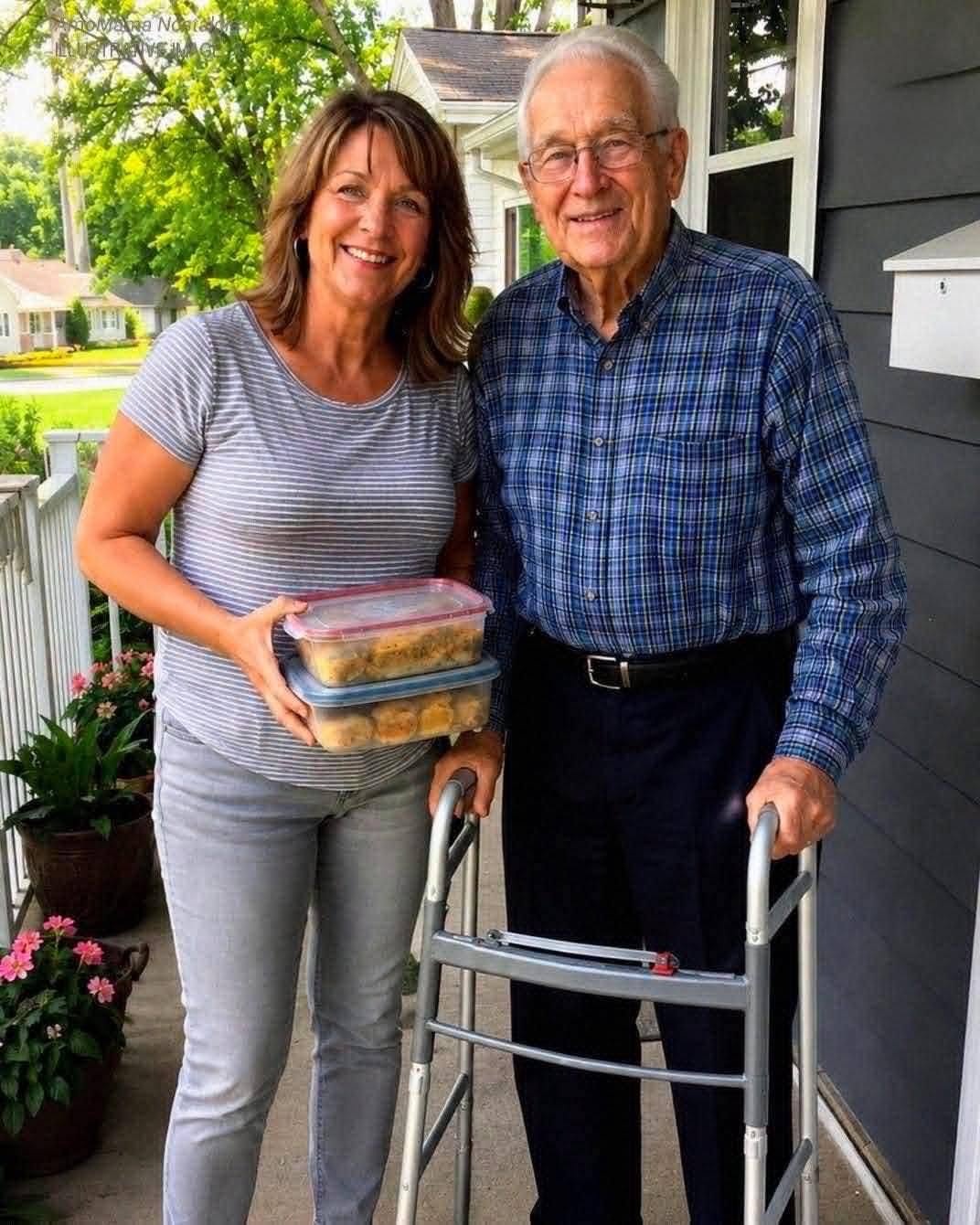
He saw me bring Lawrence meals.
He saw me pick up his prescriptions.
He saw me shovel snow from his walkway.
He saw me sit beside him on his porch during summer evenings.
And eventually, he realized something.
His father wasn’t alone anymore.
Lawrence wrote that his son had asked him about me.
“Who is she?”
Lawrence’s answer was simple.
“She’s my neighbor.”
But his son had apparently replied:
“No. She’s more than that.”
I wiped my eyes and kept reading.
Lawrence’s son had started visiting him again.
Quietly at first.
Then regularly.
Lawrence never told me.
He didn’t want me to feel that my kindness was being watched or judged.
He simply allowed the relationship between father and son to rebuild.
And according to the letter, I had unknowingly become part of the reason they found each other again.
Then I reached the final pages.
Lawrence explained the purpose of the metal box.
Inside were photographs.
Dozens of them.
Some showed Lawrence as a young man.
Others showed his late wife.
There were pictures of his son as a child.
And then there were photographs of me.
Standing on Lawrence’s porch with a casserole dish.
Carrying grocery bags.
Shoveling snow.
Laughing beside him at a neighborhood barbecue.
I had no idea anyone had taken those pictures.
At the very bottom was one final photograph.
It showed Lawrence sitting at his kitchen table.
His son was beside him.
And between them was a plate of food.
My food.
The picture had been taken several years earlier.
On the back, Lawrence had written:
This is the day my son came home.
I covered my mouth.
For nine years, I had believed I was simply helping an elderly neighbor.
I had never realized that my small acts of kindness had become part of a much bigger story.
But there was still one thing I didn’t understand.
Why had Lawrence told me to look inside the freezer?
The answer was in the last paragraph.
I know you will wonder why I kept these things in your basement. The freezer was originally mine. When you bought this house, the previous owner offered to leave it behind. I asked him to keep it there. I knew that one day I would have to tell you the truth.
I looked at the old appliance.
Lawrence had apparently purchased the house years before I moved in, before selling it to the family who eventually sold it to me.
The freezer had been forgotten.
Except by Lawrence.
Then I read the final sentence.
You always said you were only bringing me dinner. You were wrong. You were bringing me reasons to keep going. And because of you, I had the courage to open my door to my son again.
I couldn’t hold back my tears.
I sat there on the basement floor, surrounded by boxes and old memories, thinking about all those ordinary evenings.
The soup.
The groceries.
The medicine.
The conversations.
I had never considered any of it important.
To me, it was simply what neighbors did.
But perhaps that was the point.
Sometimes the things we consider small can become enormous in someone else’s life.
The next morning, there was a knock at my front door.
I opened it.
A man I had never met was standing on my porch.
He looked to be in his fifties.
For a moment, neither of us spoke.
Then he said my name.
“You’re Lawrence’s neighbor.”
I nodded.
His eyes immediately filled with tears.
“I’m his son.”
I stepped aside and invited him in.
We sat at my kitchen table for nearly three hours.
He told me that Lawrence had spoken about me constantly.
Not about the food.
Not about the medicine.
But about how I had made him feel less alone.
Then he told me something that Lawrence hadn’t included in either letter.
“Every time I came to see my father,” he said, “he asked me the same question.”
“What question?”
He smiled sadly.
“He always asked me if I had thanked you yet.”
I started crying again.
The man reached into his coat pocket and pulled out a small photograph.
It was a picture of Lawrence and me sitting on his porch.
I remembered that day.
It had been raining.
Lawrence had insisted I stay for coffee because he didn’t want me walking home in the storm.
I had forgotten all about it.
But Lawrence hadn’t.
His son placed the photograph on the table.
“I think he wanted you to have this.”
I held it carefully.
Then he said something that I will never forget.
“My father spent years believing he had lost his family. But you showed him that sometimes family isn’t only the people who share your blood. Sometimes it’s the person who notices your light is on and knocks on your door.”
After he left, I went downstairs one more time.
I opened the freezer.
The metal box was still there.
But now I understood why Lawrence had chosen that place.
It wasn’t really about the freezer.
It was about the things people overlook.
The old appliance.
The forgotten basement.
The quiet neighbor.
The extra bowl of soup.
The small act of kindness that seems insignificant at the time.
For nine years, I thought I was the one helping Lawrence.
I never realized that he had been leaving something for me, too.
Not money.
Not property.
Not some grand inheritance.
He left me a story.
A reminder that kindness doesn’t always come back to you in the way you expect.
Sometimes it returns as a letter.
Sometimes as a photograph.
And sometimes, years later, as a knock on your door from someone who simply wants to say:
“Thank you for taking care of my father when I wasn’t there.”



0 comments:
Post a Comment