The Invasive Bug Raising Concerns Across the Country—What Experts Want You to Know
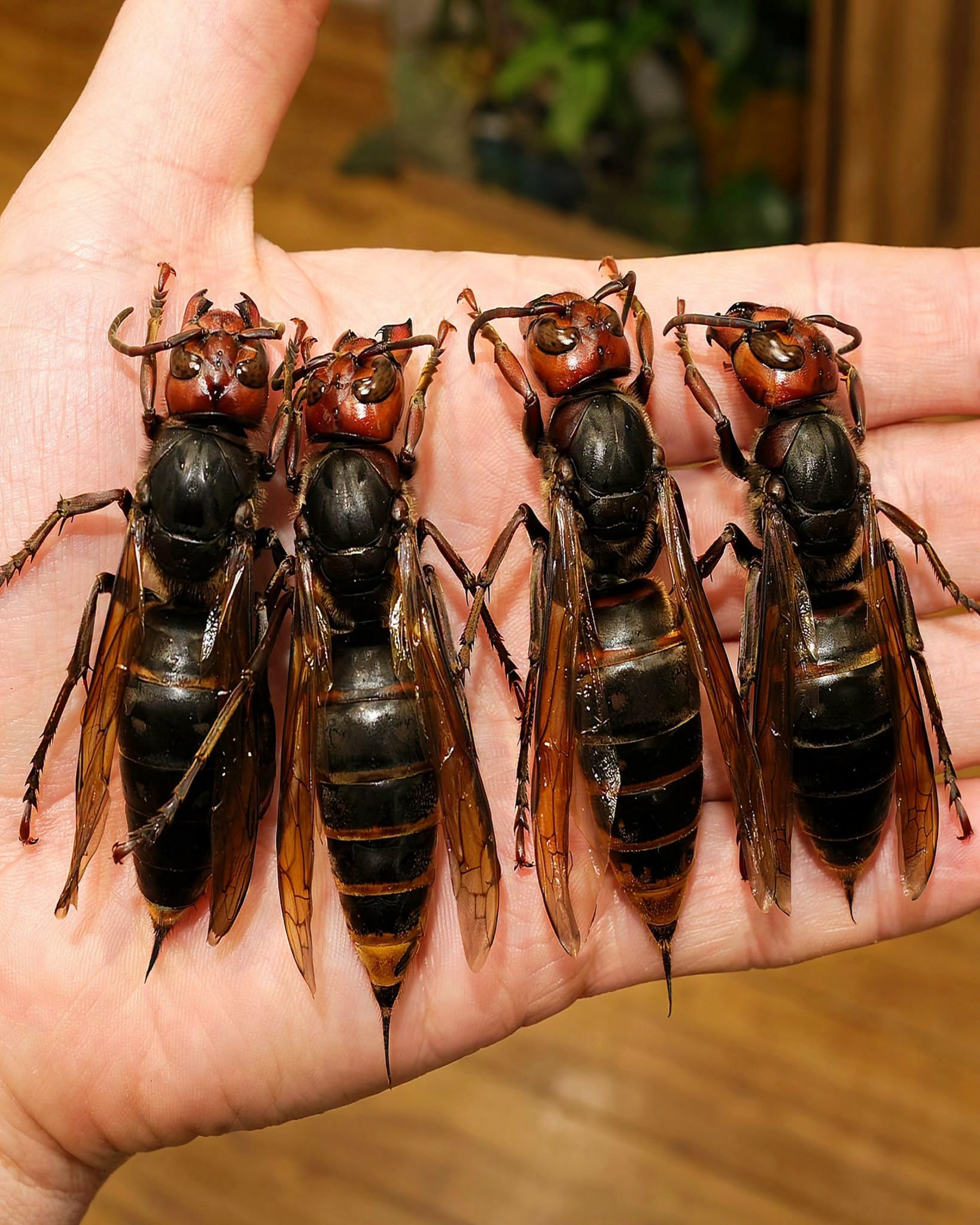
Northern giant hornets are predators of other insects, and honeybee colonies can provide an enormous source of food.
A group of hornets may attack a colony and kill worker bees before gaining access to the hive.
The objective isn’t simply to destroy the colony.
The hornets can then feed on the developing brood—the larvae and pupae inside the hive—which provides valuable protein for their own young.
For beekeepers, this makes the discovery of even a single established colony a serious concern.
Honeybees are essential pollinators, supporting agricultural production and wild plant communities around the world.
That means an invasive predator capable of putting additional pressure on bee colonies is not something scientists can afford to ignore.
Why Asian Honeybees Have an Advantage
One of the most fascinating parts of this story is that some Asian honeybees have evolved a remarkable defense.
When certain hornets enter their territory, the bees can surround the predator in a dense cluster.
They then generate heat through rapid muscle activity.
The result can create conditions that the invading hornet cannot tolerate.
It’s an extraordinary example of evolution producing a defense against a specialized predator.
Western honeybees, however, did not evolve alongside northern giant hornets.
That means they generally lack the same highly developed defensive behavior.
And that’s one reason scientists became so concerned about the possibility of the hornet establishing itself in North America.
But What About People?
The nickname “murder hornet” makes the insect sound like a creature that actively seeks out humans.
That’s misleading.
Northern giant hornets are primarily predators of other insects. They aren’t naturally interested in chasing people.
However, like many stinging insects, they can become dangerous when their nest is threatened or disturbed.
Their sting can be extremely painful, and multiple stings can present serious medical risks, particularly for people who have severe allergic reactions.
The safest response to a suspected nest is not to investigate it yourself.
It’s to keep your distance and contact the appropriate local authorities or agricultural officials.
The Race to Find the Nests
When northern giant hornets were detected in the Pacific Northwest, scientists faced a difficult problem.
Finding one hornet wasn’t enough.
If a colony existed nearby, researchers needed to locate it before queens could establish additional colonies.
So officials and entomologists developed a strategy based on tracking.
Specialized traps were placed in areas considered high-risk.
When researchers captured a live hornet, they could attach a tiny tracking device and release it.
Then came the difficult part.
Teams followed the signal through dense vegetation, attempting to trace the insect back to its nest.
The process required patience, specialized equipment, and careful coordination.
And the stakes were high.
A hidden nest could contain a colony capable of producing new queens, potentially allowing the species to spread.
What Happened When Nests Were Found?
Once a nest was located, trained eradication teams could move in with specialized protective equipment and procedures.
The goal was straightforward:
Eliminate the colony before it could reproduce and spread.
Some nests were found underground, while others could be located inside cavities.
Teams used carefully controlled methods to remove the insects and prevent the colony from surviving.
These operations demonstrated why early detection matters so much when dealing with invasive species.
Finding an invasive population while it’s still small can make containment dramatically more achievable.
Waiting until it becomes widespread can make the problem exponentially harder.
The Bigger Lesson
The northern giant hornet story isn’t simply about one unusually large insect.
It’s about how easily biological threats can cross borders.
Modern trade allows insects and other organisms to travel vast distances inside cargo, shipping materials, plants, and other goods.
Most of these accidental introductions never become major problems.
But occasionally, an organism enters an environment where conditions are favorable and natural ecological controls are different.
That’s when an invasive species can begin changing the balance of an ecosystem.
And once that happens, reversing the damage can be extremely difficult.
What Happens Next?
Scientists continue to monitor areas where northern giant hornets have been detected and remain alert for new sightings.
Public awareness is an important part of that effort.
But there’s a crucial distinction between spotting a suspicious insect and trying to deal with it yourself.
If someone believes they’ve encountered a northern giant hornet or discovered a possible nest, the safest approach is to avoid disturbing it and report the observation through the appropriate local agricultural or environmental authority.
The goal isn’t to create panic.
It’s early detection.
Because the most powerful weapon against an invasive species may not be a trap, a tracking device, or an eradication team.
It may be discovering the problem before it has a chance to grow.
And that’s what makes the northern giant hornet story so important.
It isn’t a story about a mythical monster descending from the sky.
It’s a real-world lesson in ecology, evolution, agriculture, and biosecurity—and a reminder that sometimes the smallest organisms can create some of the biggest challenges.




0 comments:
Post a Comment